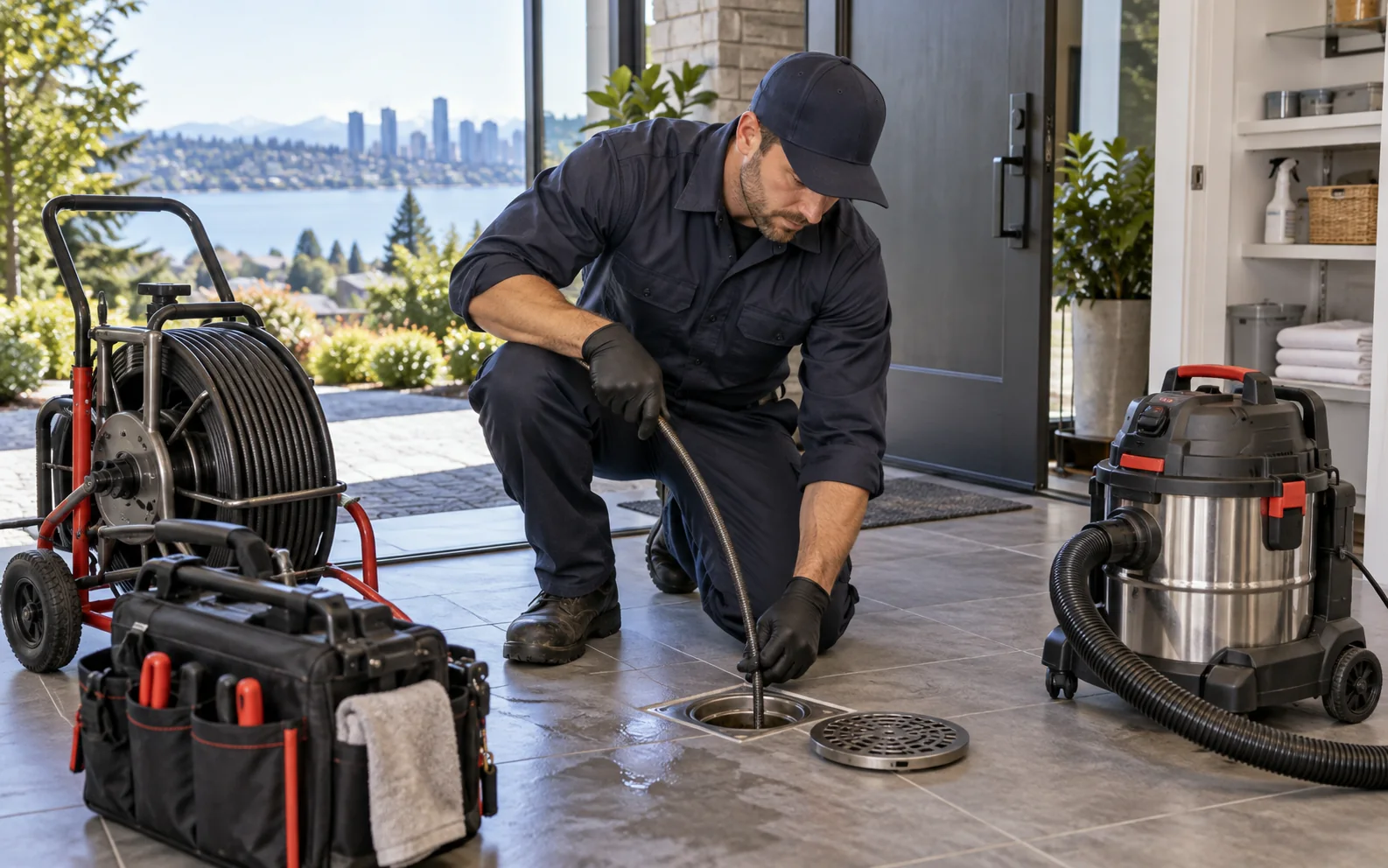
Most slow sinks in Bellevue clog in one of two places: kitchen grease coating a long horizontal run, or hair and soap scum packed at a bathroom sink's stopper and P-trap. A technician clears the stopper, trap, and branch line with a small cable, then tests the sink under a full basin of water. If both bowls back up together, or other fixtures slow too, the restriction sits deeper — and you will be told so before any larger work is quoted.
Why a Kitchen Sink Slows Down
Grease leaves the pan liquid, travels a few feet, and cools against the wall of the horizontal run to the stack — a long, nearly flat stretch under the floor in many Crossroads and Lake Hills ranch kitchens. Layer by layer, until one day the sink starts holding water during dishes.
The garbage disposal is usually blamed — as a cause, not as the clog itself. It grinds food; it does not clear the line. Eggshells become grit in the run's low spots, coffee grounds act like sediment, rice and pasta swell into a starch plug. All of it lands in the grease layer downstream.
Double-bowl sinks locate the problem. Run the disposal and water rises in the other bowl? Both bowls drain fine alone — the blockage is past their shared junction, in the trap arm or branch. Only the non-disposal bowl slow? The restriction is on that bowl's side, before the junction.
Why a Bathroom Sink Slows Down
Bathroom sinks clog close to the basin, with a recipe: hair plus soap. Hair catches on the pop-up stopper stem a few inches down, and soap scum and toothpaste coat it — and the P-trap — until the mat is a plug. It builds slowly: ten extra seconds, then a minute, then gray water standing after every use.
In Bellevue's older bathrooms, the branch behind the wall is often cast iron narrowed with scale — West Bellevue's 1950s–60s stock especially. A scaled pipe catches hair far faster than a smooth one, which is why one sink clogs twice a year while a newer bathroom never does. Fixture patterns: bathroom drain cleaning.
A Slow Sink Is the Cheap Warning
A sink that drains slowly is a clog at its smallest, cheapest stage — stopper or trap, cleared in one short visit. Left in place, it becomes a full stoppage. If the basin holds water for more than a minute, the warning period is over.
Call with the details