
One Fixture Slow
Almost always local: stopper, trap, or the first feet of branch. Common in Bellevue's 1960s–80s bathrooms where original tubs still run on original stoppers that have caught a decade of hair.
Bathroom drain cleaning in Bellevue usually means hair and soap film at a stopper or trap — a short, inexpensive fix. When the whole bathroom slows together, it means something else entirely. The visit starts by telling the two apart.
Nine bathroom clogs out of ten live within two feet of the drain opening: hair knotted around a tub stopper, soap and toothpaste scale in a sink trap, a cotton swab wedged in a bend. Clearing one bathroom drain in Bellevue typically runs about $150–$300, and most visits are exactly that simple. The tenth case is the one worth diagnosing properly — when the tub, sink, and toilet in the same bathroom all slow down together, the problem sits in the shared branch or the main line, and clearing fixtures one by one will chase it around the room. The visit starts by telling those two situations apart, because the fix, the cost, and the prognosis are completely different.
Pop-up and trip-lever stoppers are hair magnets by design — they sit in the flow and catch everything. If your tub drains slowly but the sink and toilet are fine, the blockage is almost certainly at the stopper or the trap just below it. That is a short, inexpensive fix, and it is also the one most likely to be sold as something bigger elsewhere. We will show you what came out.
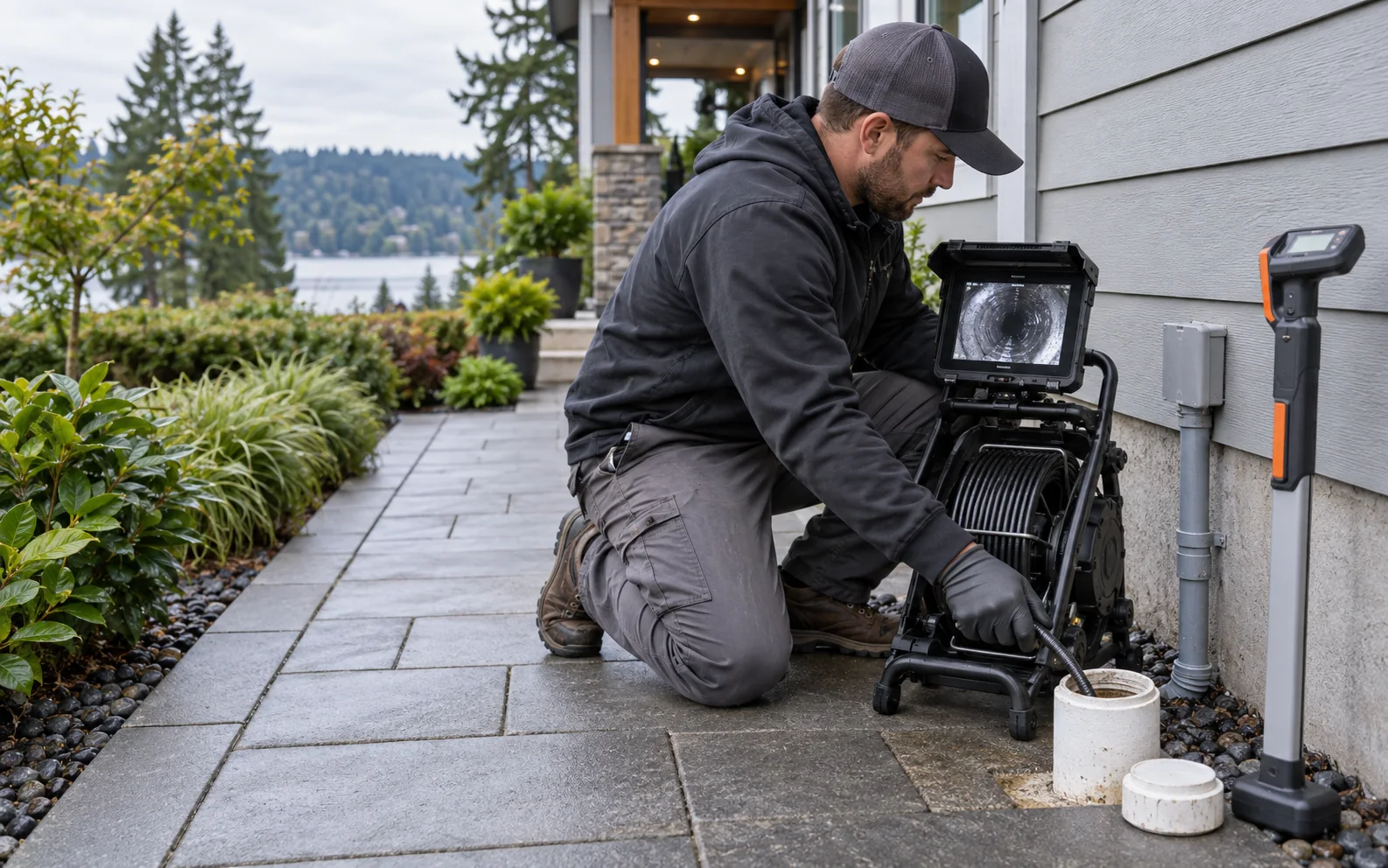
Call with the detailsEach fixture gets tested in sequence — sink, tub or shower, then a toilet flush — because the pattern across fixtures is the diagnosis. A single slow fixture is cleared at the fixture: stopper removed and cleaned, trap opened if needed, and a small cable run into the branch to catch what the stopper missed. When several fixtures share the slowdown, the cable goes to the branch line instead, and if the pattern reaches beyond the bathroom, the scope widens to the main sewer line with a camera to see exactly where. Hair and soap come out as a mat; scale and rust come out as grit — what comes back on the cable tells us what the pipe is doing inside.
Clearing one bathroom fixture drain in Bellevue typically runs about $150–$300. A shared-branch clearing is scoped once the pattern is clear, and if testing shows a main line problem, main line clearing typically runs about $250–$500. You approve the scope that matches the diagnosis — a stopper cleaning never quietly becomes a line job.
Bathrooms are plumbed in groups, and the group tells the story. Fixtures that share a wall or stack share a branch — and share its problems.
Almost always local: stopper, trap, or the first feet of branch. Common in Bellevue's 1960s–80s bathrooms where original tubs still run on original stoppers that have caught a decade of hair.
Sink, tub, and toilet all sluggish means the shared branch is restricted — often where the branch meets the stack, or where an old galvanized section has scaled down to a fraction of its size.
In split-level and daylight-basement homes across Somerset, Woodridge, and Lake Hills, the lowest bathroom shows a main line restriction first. Gurgling there during laundry cycles is the classic early warning.
Run each fixture in the bathroom one at a time and note which are slow, then flush the toilet and watch the tub drain. That two-minute test, reported on the call, separates a stopper job from a branch job before anyone arrives.
Bathroom patterns connect to the fixtures and lines around them:
A simple mesh catcher over the tub drain stops most hair before it reaches the stopper — the cheapest drain maintenance there is. Run hot water for half a minute after shaving or washing hair to move soap film through the trap instead of letting it set. And once a year, lift the sink stopper and clean what is hanging on it; five minutes there prevents the classic slow-sink call. If a fixture still slows on a repeating cycle after the fixture itself is clean, the cause is deeper — the same recurrence logic our slow drain guide lays out.
One slow drain, others normal, no gurgling anywhere. Expect a stopper-and-trap visit at the single-fixture range — the most common bathroom call there is.
Every fixture in one bathroom is slow, but the rest of the house is fine. The shared branch gets cabled and, if scale is the story, scoped for what comes next.
More than one bathroom involved, or the lowest fixtures react to water used upstairs. That is a main line pattern — fixture work would only move the problem around.
Shower drains clog fastest (hair plus body-wash film, flat traps). Tub stoppers hide the biggest mats. Sink traps collect the scale. Each clears a little differently — the visit adapts to the fixture, not a script.
These views match the kind of fixture, line, outdoor feature, or operating context that can change the first conversation for bathroom drain cleaning.

The map provides local contact context for Bellevue Rapid Drain. It does not determine boundaries, responsibility, response time, or serviceability.
Most often, a mat of hair and soap film has built up on the stopper mechanism and in the first bend below the drain. It forms gradually, which is why the slowdown feels sudden only at the end. Clearing the stopper and trap usually restores full flow.
Clearing one bathroom fixture drain typically runs about $150–$300. If several fixtures share a restricted branch, the branch work is scoped after testing; main line problems, when found, typically run about $250–$500 to clear.
It is one problem in a shared pipe — the branch line serving that bathroom, or the main line beyond it. Clearing individual fixtures will not hold. The branch gets cabled and the pattern re-tested, with a camera if the restriction is not obvious.
They are a poor tool here. Hair mats barely respond to them, the chemicals sit in the trap as a hazard for whoever opens it, and repeated use can damage older pipe and finishes. A mesh hair catcher prevents more clogs than any chemical treats.
Fit a simple mesh or silicone hair catcher over the drain, empty it weekly, and run hot water briefly after showers to move soap film through the trap. If the drain still slows on a cycle with a clean stopper, the restriction is deeper in the branch.
Share which fixtures are slow and which are fine — that pattern is the diagnosis, and it decides whether this is a stopper job or a line job.
Contact Bellevue Rapid Drain