A floor drain is the lowest opening in your drainage system, so it complains first — sometimes about its own clog, sometimes about the main line behind it. This page separates the two, because they are different jobs with different fixes.
The Straight Answer: Why Floor Drains Back Up
A floor drain backs up for one of two reasons. Either its own trap and short branch are clogged with sediment and debris, or the main sewer line is restricted and wastewater is surfacing at the lowest opening in the house — the floor drain. If yours only misbehaves when the washer drains or a toilet flushes, and other fixtures gurgle too, the main line is talking; the floor drain is just where you can see it.
Two Problems, One Symptom: Its Own Clog vs. the Main-Line Warning
Its own clog builds slowly and stays local. Floor drains in garages, basements, and utility rooms collect what floors collect: grit, sediment, lint, pet hair, mop-water residue. The trap and the short branch behind it fill gradually. The tell: the drain is slow even when nothing else has run for hours, and every other fixture drains perfectly.
The main-line warning behaves the opposite way. The floor drain itself is clear, but it is the lowest opening on a restricted main line — so when a large volume of water cannot get through fast enough, it rises here. The tell: it surfaces during discharge, other fixtures are involved, and what comes up can be wastewater, not clean water. Separate the two before anyone arrives:
Pour two buckets of water at the drain with nothing else running — slow to take it means its own trap and branch
Fine on its own but surfaces during laundry points to the main line
A toilet that gurgles while the floor drain surges confirms the main line
Odor with no water at all is neither — it is a dry trap, covered below
What to Share When You Call
The room, what was running when it backed up, whether any other fixture is slow or gurgling, any smell when the drain is dry, and how many times it has happened — those five answers usually sort the job before the visit.
A washing machine is the stress test of a home's drainage: it empties its full tub in a couple of minutes — a faster, larger surge than any sink, shower, or toilet sends down the line. A partial main-line restriction passes everyday flows without complaint but cannot pass that surge, so the water takes the lowest exit. In many Bellevue homes the washer and floor drain sit side by side at the lowest level: fine all week, flooding on laundry day. A drain that only fails under laundry load is reporting a partial restriction early — it will not stay partial.
How a Floor Drain Is Cleaned
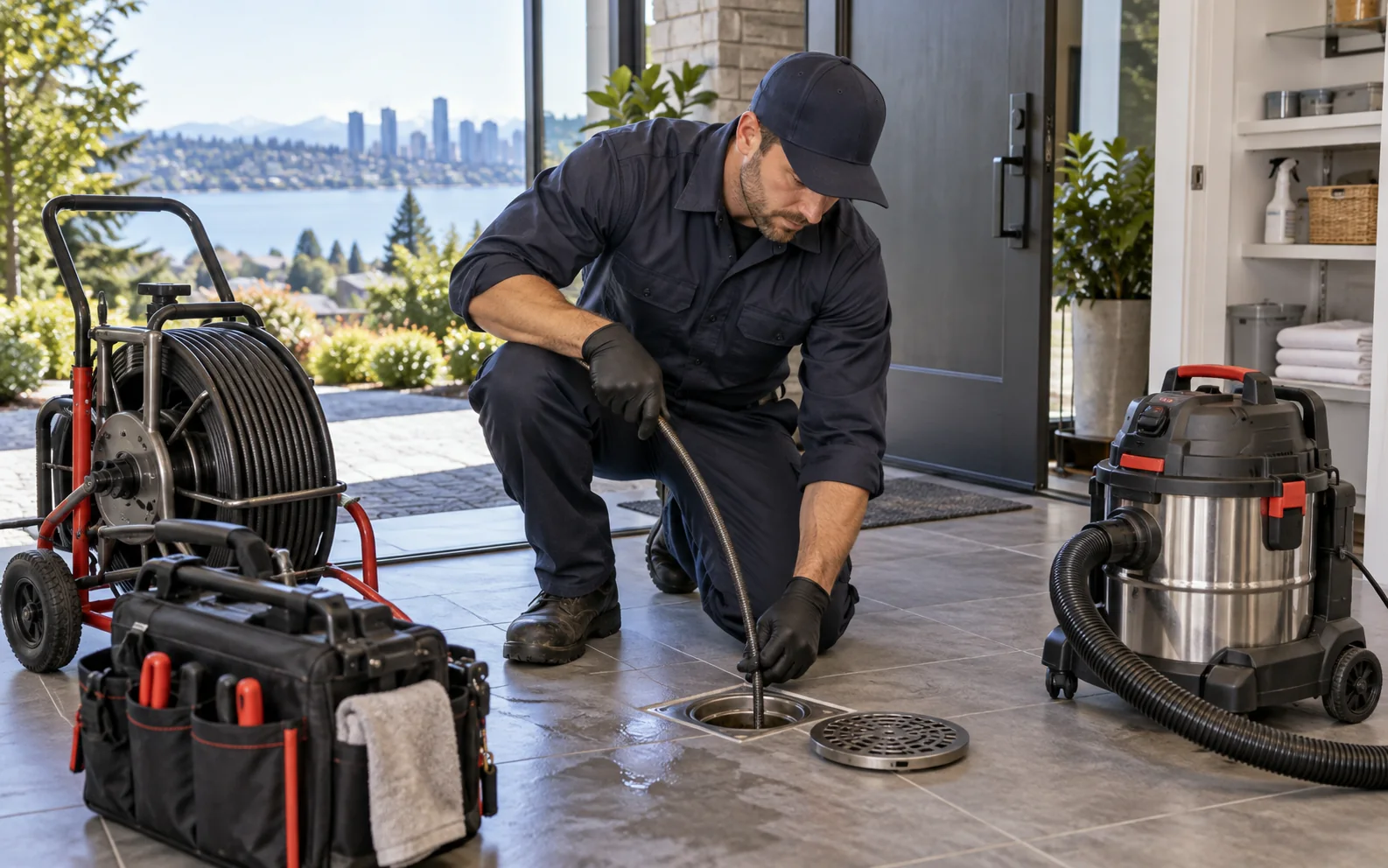
Grate and trap service. The grate comes off and the trap is cleaned by hand — packed sediment lives there, and no cable cleans a trap like emptying it.
Cable the branch. A cable clears the floor-drain line from the trap to where it joins the main.
Flood test under load. Fixtures and the washer run while the drain is watched, to prove whether the problem stops at the branch.
Camera if it recurs. A floor drain that keeps clogging is fed by a main-line cause — roots, a belly, scale — that trap cleaning cannot reach.
If the flood test shows the main line is the real cause, we will say so plainly and walk you through main sewer line cleaning — what it involves and what it costs — before that work begins. A floor drain visit never quietly becomes a main-line job without that conversation.
The Sewer Smell With No Backup: A Dry Trap
Every floor drain has a trap — a bend holding a plug of water as a seal against sewer gas. In a drain used weekly, the seal maintains itself. In a garage, basement, or spare-bathroom drain that goes months between uses, the water evaporates — faster in heating season — and the open pipe starts venting sewer smell into the house. Nothing is clogged; the seal is simply gone.
The fix is a bucket of water poured down the drain. Floating a little mineral oil on the surface afterward slows evaporation for months. Drains that dry out constantly — common in commercial spaces and second homes — can take a trap primer that tops it up automatically. If the smell continues with water standing in the trap, the cause is not evaporation, and fragrance only delays finding it.
When a Floor Drain Backup Is an Emergency
Treat it as an emergency when what is coming up is sewage rather than clear water, when water is spreading toward a furnace, water heater, or electrical panel, when it is entering finished living space, or when you cannot stop the source. Stop using water, keep people and pets out of it, and call for emergency drain cleaning. If sewage has spread across a finished floor, cleanup (extraction and disinfection — see sewage cleanup) is its own job, separate from clearing the line. A slow drain passing clear water, with everything else normal, is a scheduled visit, not a siren.
What Floor Drain Cleaning Costs
A floor-drain-only job — trap service and a branch cable — typically runs about $150–$300 in the Bellevue area. When testing shows the main line is the cause, the work becomes main line cleaning, typically about $250–$600 depending on access and severity. What moves the price: a trap cleanout plug that works versus one corroded shut, finished space that needs protecting, and whether recurrence warrants a camera. Either way, you know which job you have — and its price — before work starts.
Why it matters
Why Floor Drains Act Up in Bellevue Homes
Postwar Bellevue layouts put the laundry, the furnace, and the floor drain together at the lowest level of the house, draining into laterals of the same era. That combination explains most of what floor drains here actually do.
Sediment, Lint, and Sweepings
A floor drain swallows whatever the floor offers: garage grit, basement dust, laundry lint, pet hair, mop residue. It collects in the trap until the trap holds a plug of solids instead of a water seal — the slowest, most ordinary floor drain failure, and the easiest to fix once recognized.
Laundry at the Lowest Level
In the postwar homes of Lake Hills, Crossroads, and Newport, the washer sits steps from the floor drain — and the washer is the highest-volume discharge in the house. That is why so many floor drain calls are really main-line calls: the laundry surge is the first load big enough to expose the restriction.
Dry Traps in Quiet Corners
The drains nobody uses — the garage corner, the spare bathroom, the utility closet — lose their trap water to evaporation and start smelling like a sewer problem that does not exist. It is the most misdiagnosed floor drain complaint: the entire repair is a bucket of water and a float of mineral oil.
Next steps
Floor Drain Next Steps in Bellevue
The first job is to stop adding water: whatever filled the drain is still arriving until the source stops. Then a few calm observations turn a wet floor into useful information.
Stop the fixture that triggers it — usually the washer — and hold off on showers and flushing
Keep people and pets out of the water until you know whether it is wastewater
Run the 60-second check: does anything else gurgle or drain slowly?
If water is spreading, photograph the high-water mark — cleanup and insurance both use it
Related Bellevue Drain Services
When the floor drain points beyond itself, these are the pages that take over — or browse all Bellevue drain services to match a different symptom.
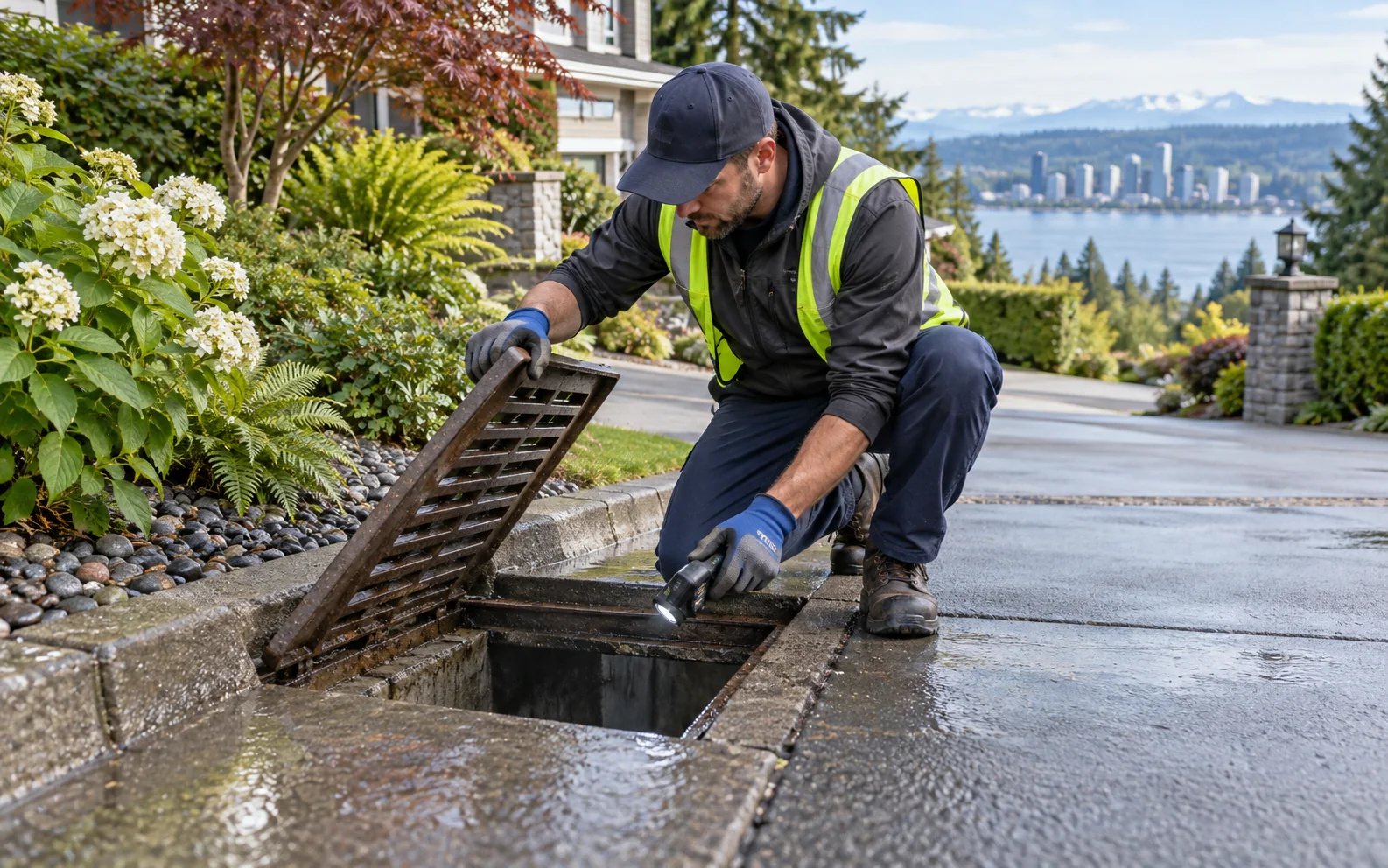
An indoor floor drain connects to the sanitary side sewer — the same pipe as your toilets — so water appearing at one is wastewater until proven clean. Yard, patio, and driveway drains belong to a separate storm system, covered under storm drain cleaning. And a floor drain that surfaces only under load is usually neither: it is the main line, announcing itself at the lowest point it can find.
Service guidance
Choose the Right Floor Drain Path in Bellevue
Only the Floor Drain Is Slow
Nothing else misbehaves, and the drain is slow even at rest. That is its own trap and branch — a contained job: hand-clean the trap, cable the branch, flood-test, done. Most sediment-filled garage and basement drains live here.
It Rises When Water Runs
The drain behaves until the washer discharges or several fixtures run together, then it surfaces. That timing is the fingerprint of a restricted main line using the floor drain as its relief valve — the fix belongs on the main sewer line.
Smell, but No Water
Start with the trap, not a tool: refill it with water, float a little mineral oil on top, and see whether the smell is gone within the hour. If it dries out and the smell returns within weeks, a trap primer ends the cycle. A smell that persists with a full trap is a different diagnosis.
Sewage on a Finished Floor
Once sewage is across a finished basement or living space, two jobs exist at once: stop the cause in the line, and make the space safe again. The second is sewage cleanup — extraction, disinfection, and drying — and it should not wait.
Service intent
Details That Guide Your Floor Drain Cleaning Visit
Location, trigger, and water type decide whether this is a trap job, a branch job, or a main-line visit wearing a floor drain's face.
The trap is serviced by hand first — most floor-drain debris never needs a cable at allIndoor floor drains and outdoor inlets are different systems — the visit confirms which one is talking
Bellevue location context
Floor Drain Cleaning Service Area in Bellevue, WA
The map provides local contact context for Bellevue Rapid Drain. It does not determine boundaries, responsibility, response time, or serviceability.
Address on file1633 151st Ave SE Bellevue, WA 98007
Why does my floor drain back up when the washer runs?
A washing machine empties its tub in a few minutes — the fastest, largest discharge in the house. If the main line is partly restricted, sink and toilet flow still get through, but the washer's surge cannot, so water surfaces at the lowest point: the floor drain. A drain that only misbehaves on laundry day is reporting a main-line problem, not its own clog.
Can a floor drain clog on its own, or is it always the main line?
Both happen, and a simple test tells them apart. A floor drain clogs on its own when its trap and branch collect sediment, lint, and sweepings — it is slow even when nothing else is running, and every other fixture drains fine. If other fixtures gurgle or slow at the same time, the floor drain is only the messenger; the main line is the problem.
How is a floor drain cleaned?
The grate comes off and the trap is cleaned by hand first — that is where most floor-drain debris collects. Then a cable clears the floor-drain line out to the main. A flood test follows, running other fixtures to confirm whether the problem stops at the branch or continues into the main line — where a camera goes in if backups keep returning.
Why does my floor drain smell like sewer when there is no backup?
Almost always a dry trap. The trap holds a plug of water that seals sewer gas out, and in a rarely used drain — garage, basement, spare bathroom — that water evaporates within weeks. A bucket of water restores the seal; a little mineral oil floated on top slows evaporation. If the smell returns while the trap holds water, the cause is elsewhere and worth a look.
When is a floor drain backup an emergency?
When what is coming up is sewage rather than clear water, when water is spreading toward a furnace, water heater, or electrical panel, or when it is entering finished living space. Stop using water, keep people and pets out of it, and call for emergency service. A slow drain with clear water and no symptoms is urgent, but it can wait for a scheduled visit.
What does floor drain cleaning cost?
A floor-drain-only clog — trap and branch work — typically runs about $150–$300 around Bellevue. When testing shows the real blockage is in the main line, the job becomes main line cleaning, typically about $250–$600 depending on access and severity. Either way, you will know which job you have, and its price, before any work starts.
The backup keeps coming back. What does that mean?
A floor drain that clogs again within weeks is saying the restriction sits downstream, in the main lateral — roots, a belly holding solids, or scale that trap cleaning cannot reach. Re-cleaning the trap treats the symptom at the lowest point. The next step is a camera inspection of the main line, so the cause is found and cleaned once, in the right place.
Get Floor Drain Cleaning Help in Bellevue
Tell us the room, what was running when it backed up, and whether anything else is slow — that is usually enough to know which of the two problems you have.